
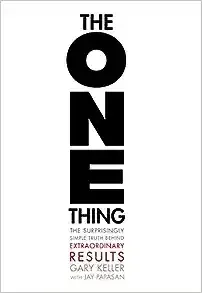
The ONE Thing: The Surprisingly Simple Truth About Extraordinary Results
"What's the ONE THING I can do, such that by doing it, everything else will be easier or unnecessary?"- Gary Keller
Summary: In this book, Keller emphasizes the importance of focusing on one thing at a time, rather than trying to multitask and spreading oneself too thin. The book includes various quotes, such as "Be like a postage stamp - stick to one thing until you get there," and discusses six lies between readers and success: everything matters equally, multitasking, a disciplined life, willpower is always on will-call, a balanced life, and big is bad. The book encourages readers to ask themselves the focusing question: "What's the ONE THING I can do, such that by doing it, everything else will be easier or unnecessary?"
💡 The Focusing Question of the book: "What's the ONE THING I can do, such that by doing it, everything else will be easier or unnecessary?"
Quotes Used in Book
Be like a postage stamp - stick to one thing until you get there. - Josh Billings
Things which matter most must never be at the mercy of things which matter least - johann wolfgang von goethe
The things that are the most important don't always scream the loudest - bob hawke
It's not enough to be busy, so are the ants. The question is, what are we busy about? - Henry David Thoreau
The rung of a ladder was never meant to rest upon, but only to hold a man's foot long enough to enable him to put the other somewhat higher - Thomas Henry Huxley
But those Woulda-Coulda-Shouldas all ran away and hid from one little Did - Shel Silverstein
Even if you're on the right track, you'll get run over if you just sit there - Will Rogers
Planning is bringing the future into the present so that you can do something about it now - Alan Lakein
Day, noun. A period of twenty-four hours, mostly misspent - Ambrose Bierce
To get through the hardest journey we need take only one step at a time, but we must keep stepping - Chinese Proverb
City Slicker's Quote: Curly tells Mitch the secret of life. To stick to the one thing!
Go Small: Extraordinary results are directly determined by how narrow you can make your focus. You only have so much time and energy, so when you spread yourself out, you end up spread thin.
The Domino Effect: a geometric progression. One small domino can take down things so much larger than it's size, due to this effect. i.e. the 31st domino would loom over Mt Everest and the 57th would practically bridge the distance between the earth and moon.
Find the lead domino, and whack away at it until it falls.
Success is sequential, not simultaneous. What starts linear becomes geometric.
The key is over time. Success is built sequentially. It's one thing at a time.
Frog scenario: put a frog in boiling water and he will jump out. Put a frog in luke warm water and slowly increase the temperature, and you will boil the frog.
The Six Lies between you and Success:
Everything matters equally
Equality is a lie - understanding this is the basis of all great decisions
Don't get caught checking items off to-do lists.
Achievers do sooner what others plan to do later and defer, perhaps indefinitely, what others do sooner.
Narrow your to-do's to ONE!
The inequality of effort for results is everywhere in your life if you will simply look for it.
Big Ideas:
Go Small: don't focus on being busy; focus on being productive. Allow what matters most to drive your day
Go Extreme: one you've figured out what matters, keep asking what matters most until this is only one thing left. Put that activity at the top of your success list
Say No: whether you say "later" or "never", the point is to say "not now" to anything else you could do until your most important work is done.
Don't get trapped in the "check off" game: everything doesn't HAVE to be done. Success is found it doing what matters most.
Multitasking
It's impossible to do two tasks well at the same time.
Its not that we have too little time to do all the things we need to do, its that we feel the need to do too many things in the time we have.
Big Ideas:
Distraction is Natural: don't feel bad when you get distracted. Everyone gets distracted
Multi-tasking takes a toll. Distractions lead to poor choices, painful mistakes, and unnecessary stress
Distraction undermines results. When you try doing to much, you do none of it well.
A disciplined life
The truth is, we don't need anymore discipline than we already have. We just need to direct and manage it a little better.
Success is actually a short race - a sprint fueled by discipline just long enough for habit to kick in and take over
Regularly work at something until it regularly works for you!
Disciplined people are actually those who have just trained a handful of habits into their lives.
Success is about doing the right thing, not about doing everything right!
The trick to success is to choose the right habit and bring just enough discipline to establish it.
When you do the right thing, it can liberate you from having to monitor everything.
A study showed that on average, it takes 66 days for a new behavior to become a habit.
If you are what you repeatedly do, then achievement isn't an action you take but a habit you forge into your life.
Big Ideas:
Don't be a disciplined person. Be a person with powerful habits and use selected discipline to develop them
Build one habit at a time. Success is sequential, not simultaneous. One at a time. Over time.
Give each habit enough time.
Willpower is always on will-call
Willpower has a limited battery life. Like your phone, you are fully charged in the morning. This charge is depleted throughout the day. We all have a limited supply.
Everyone accepts that limited resources must be managed, yet we fail to recognize that willpower is one of them.
Make doing what matters most a priority when your willpower is its highest.
Taxations of will power:
Implementing new behaviors
Filtering distractions
Resisting temptation
Suppressing emotion
Restraining aggression
Suppressing impulses
Taking tests
Trying to impress others
Coping with fear
Doing something you don't enjoy
Selecting long-term over short-term rewards!
Our willpower must be managed!
Big ideas:
Don't spread your willpower too thin. Decide what matters most each day and reserve your willpower for it
Monitor your fuel gauge.
Time your task. Don't fight your willpower, build your days around how it works.
A balanced life
Nothing ever achieves absolute balance. A balanced life is a lie.
Big ideas:
Think about two balancing buckets. Separate your work life and personal life into two distinct buckets - not to compartmentalize them, just for counterbalancing. Each has its own counterbalancing goals and approaches
Counterbalance your work bucket. Your work life is divided into two distinct areas -- what matters most and everything else. You will have to take what matters to the extremes and be okay with what happens to the rest.
Counterbalance your personal life bucket. There are many areas of your personal life that needs attention. Drop any one, and you'll feel the effects. Don't go too long or too far without counterbalancing.
An extraordinary life is a counterbalancing act!
When you're at work, do work. When your with your wife, be with your wife. This is the act of counterbalancing. Giving full attention to the task at hand, so that you can do it well.
Big is bad
What you build today will either empower or restrict you tomorrow! It will either serve as a platform for the next level success or as a box, trapping you where you are.
Choose your box, choose your outcome. Big outcome requires big actions. Small outcome requires small actions.
Examples of thinking big:
JK Rowling envisioned seven years at Hogwarts before she penned the first chapter of the first of seven books.
Sam Walton of Wal-Mart envisioned a business so big that he felt he needed to setup his future estate plan to minimize inheritance taxes. He saved his family an estimated $13Billion
Asking big questions can be daunting. Big goals can seem unattainable at first. Yet how many times have you set out to do something that seemed like a real stretch at the time, only to discover it was much easier than you thought? Sometimes however, it's harder than you imagined. That's when its important to realize that on the journey to achieving big, you get bigger! Over time you become the big person that is required to take on big feats.
As you experience big, you become big.
Don't fear big. Fear mediocrity. Fear waste. Fear the lack of living to your fullest. When we fear big, we either consciously or subconsciously work against it.
Only living big will let you experience your true life and work potential
Big Ideas:
Think Big. Avoid incremental thinking that simply asks, "What do I do next?" Ask bigger questions and you will get bigger answers. A good rule of thumb is to double down on your goals. If your goal is 10, make it 20. Set a goal so far above what you want that you'll be building a plan that practically guarantees your original goal
Don't order from the menu. Great companies and ideas have come from those who didn't order off an existing menu, but ordered their own creations. "People who are crazy enough to think they can change the world are the only ones who do."
Act bold. Big thoughts go nowhere without bold action. What are the models, systems, habits, and relationships of other people who have found the answer? As much as we like to think we are different, what consistently works for others will almost always work for us.
Don't fear failure. Adopt a growth mindset, and don't be afraid of where it can take you. Success is built on failure.
We overthink, over plan, and overanalyze our careers, our businesses, and our lives; that long hours are neither virtuous nor healthy; and that we usually succeed in spite of most of what we do, not because of it. We can't manage time, and the key to success isn't in all the things we do but in the handful of things we do well.
💡 Life is a question: the quality of any answer is directly determined by the quality of the question.
Voltaire - "Judge a man by his questions rather than his answers"
Poem
My Wage by J.B. Rittenhouse
I bargained with Life for a penny,
And Life would pay no more,
However I begged at evening
When I counted my scanty store.
For Life is a just employer,
He gives you what you ask,
But once you have set the wages,
Why, you must bear the task.
I worked for a menials hire,
Only to learn, dismayed,
That any wage I had asked of Life,
Life would have willingly paid.
How we phrase the questions we ask ourselves determines the answers that eventually become our life.
Anyone who dreams of an uncommon life, eventually discovers there is no choice but to seek an uncommon approach to living it.
The Focusing Question:
What's the ONE THING I can do, such that by doing it, everything else will be easier or unnecessary?
Big Ideas:
Great questions are the path to great answers.
The focusing question is a double-duty question. It comes in two forms: big picture and small focus. One is about finding the right direction in life and the other is about finding the right action
The big-picture question: "What's my ONE thing?". Use it to develop a vision for your life and the direction for your career or company; it's your strategic compass. It keeps your relationships with friends, family, and colleagues in perspective and your daily actions on track.
The small-focus question: "What's my ONE thing right now?". Use this when you first wake up and throughout the day. It keeps you focused on your most important work and, whenever you need it, helps you find the "levered action" or first domino in any activity.
Focusing question: apply it to all areas of your life
Spiritual life
To help others
To improve my relationship with God
Physical health
Diet goals
Ensure exercise daily
Relieve my stress
Personal life
Skills
Time for yourself
Key relationships
Spouse
Job
Your business
Your finances
Big Ideas:
Understand and believe the concept of "One Thing".
Use it. Ask yourself the focusing question.
Make it a habit.
Leverage reminders. "Until my ONE thing is done - everything else is a distraction"
Recruit support
Extraordinary Results come from…
Purpose
Priority
Productivity
Your big One Thing is your purpose and your small One Thing is the priority you take action on to achieve it. The most productive people start with purpose and use it like a compass. They allow purpose to be the guiding force in determining the priority that drives their actions.
Think of this as three parts of an iceberg. 1/9 of the iceberg might be above water and what people see. That's your productivity. But people can't see the purpose and priority that is the driving force behind your productivity.
Dr. Martin Seligman believes there are five factors that contribute to our happiness: positive emotion and pleasure, achievement, relationships, engagement and meaning. Of which he believes engagement and meaning are the most important.
Becoming more engaged in what we do by finding ways to make our life more meaningful is the surest way to finding lasting happiness.
Gary Keller has taught wealth building to all ages. When he asks "How much money do you want to earn?" he gets all kinds of answers, but usually the number is quite high. When asked, "How did you get this number?" people often respond that they don't know. Then when asked, "Can you tell me your definition of a financially wealthy person?" he gets numbers that are above a million dollars. It is and it isn't. But he tells people that he believes that financially wealthy people are those who have enough money coming in without having to work to finance their purpose in life.
Big Ideas:
Happiness happens on the way to fulfillment. We all want it, but seeking it isn't the best way to find it. The surest path to achieving lasting happiness happens when you make your life about something bigger, when you bring meaning and purpose to your everyday actions.
Discover your big why. Ask yourself what drives you. What get's you up in the morning and keeps you going when you are tired and worn down? This is your BIG WHY?
Absent an answer, pick a direction. Pick a direction, start marching down that path and see how you like it. Time brings clarity and if you find you don't like it, you can always change your mind. It's your life.
Gary's ONE thing: "My purpose is to help people live their greatest life possible through my teaching, coaching, and writing." Then he asks himself what his life should look like if that's his purpose.
Live by Priority
Cheshire Cat gives Alice advice on direction
Purpose without priority is powerless.
Priority was a singular word up until the 20th century. Priorities creeped in and other varieties of sayings like "most pressing matter", "on the front burner", came into play.
The further away a reward is in the future, the smaller the immediate motivation to achieve it. Maybe this is because objects that are further away appear smaller, so people mistakenly assume they really are and discount their value.
Goal Setting to the Now
Break it down in this order…
Someday goal: what's the one thing I want to do someday?
Five-year goal: based on the someday goal
One-year goal
Monthly goal
Weekly goal
Daily goal
Right now: what's the one thing I can do right now
Visualize the process, not just the outcome. Studies have shown that students who visualized the process performed better across the board -- They studied earlier and more frequently and earned higher grades.
People tend to be overly optimistic about what they can accomplish, and therefore most don't think things all the way through. This is called the "Planning Fallacy". Visualizing the process -- breaking a big goal down into the steps needed to achieve it -- helps engage the strategic thinking you need to plan for and achieve extraordinary results. This is why the Goal setting to Now really works.
Those who write down their goals are 40% more likely to accomplish them - 2008 Dr Gail Matthews study.
Big Ideas:
There can only be ONE priority. Dig deeper if you think you have multiple.
Goal set to the Now. Identify the steps to get to your end goal.
Put pen to paper
Productive people get more done, achieve better results, and earn far more in their hours than the rest. They devote their time to being productive on their top priority.
Time block your ONE Thing -> Protect your time block
Time Blocking
Time blocking is a way to make sure that what has to be done gets done.
Time block your time off - resting is as important as working. Time blocking this will eliminate others trying to schedule during your rest time.
Time block your ONE Thing - 4 hours, ideally, per day
Time block your planning time - 1 hour per week to review your annual and monthly goals.
Time block your mornings when your energy is high. Leave the afternoon's for meetings and administrative tasks.
Your own need to do other things instead of your ONE Thing may be your biggest challenge to overcome. There will always be other stuff screaming to be done. If stuff pops up, write it down and go back to your task at hand.
Four proven ways to battle distractions and keep your focus on the ONE Thing:
Build a bunker. Find a place to work that takes you out of the path of disruption and interruption.
Store provisions. Have supplies on hand, like snacks, to keep you from having to leave your bunker.
Sweep for mines. Turn off your phone, shut down your email, and exit your browser.
Enlist support. Tell people that you can't be disturbed. People will respect your time.
Big Ideas:
Connect the dots
Time block your ONE thing
Protect your time block at all costs.
People who achieve extraordinary results don't achieve them by working more hours. They achieve them by getting more done in the hours they work.
The Three commitments to your ONE Thing:
Follow the path of mastery: when you see mastery as a path you go down instead of a destination you arrive at, it starts to feel accessible and attainable.
Move from "E" to "P": Entrepreneurial to Purposeful.
Live the accountability cycle: take complete ownership of your outcomes by holding no one but yourself responsible for them. You can be the author or the victim of your own life. Engage mentors, coaches, teachers, to hold you accountable.
The four thieves to productivity:
Inability to say "No": you can't please everyone, so don't try.
Fear of chaos: when you strive for greatness, chaos is guaranteed to show up.
Poor health habits
Environment doesn't support your goals: no one succeeds alone and no one fails alone. Pay attention to the people around you.

WELCOME!
Real Adventures, Unforgettable Memories
Dive into a world of captivating narratives that transport you to far-flung corners of the globe. Our travel stories are more than just words; they're windows into unforgettable moments, thrilling encounters, and the magic of exploration that will leave you yearning for your own travel tales.
About Us
With our carefully crafted guides, captivating stories, and stunning photography, we aim to bridge the gap between cultures, foster connections, and encourage responsible and mindful travel. We believe that every voyage has the potential to change lives and perspectives, and we're committed to helping you make the most of your travel experiences.

OUR SERVICES
High Quality Services

Destination Reviews and Recommendations
Provide comprehensive destination reviews and recommendations for travelers. Share insights into your personal experiences, including must-visit attractions, local cuisine, and hidden gems. Offer tips on the best time to visit, budget-friendly options, and off-the-beaten-path adventures.

Travel Planning and Itinerary Assistance
Offer travel planning services where you help travelers create custom itineraries. Explain how you can assist with selecting accommodations, transportation options, and activity planning to ensure a seamless and enjoyable trip.

Travel Resources and Tips
Provide valuable resources and travel tips on your website. Offer packing lists, visa information, budgeting guides, and advice on solo travel, family travel, or travel photography. Create informative articles and guides to help travelers prepare for their adventures.

Travel Photography Workshops
If you're a travel photographer, consider offering travel photography workshops or tours. Describe how you can help photography enthusiasts improve their skills while exploring beautiful destinations. Highlight your expertise in capturing stunning travel photos.
Professionals Team
At [Your Travel Blogger Website], our team is a vibrant tapestry of individuals bound together by a shared love for travel and a passion for storytelling. We come from diverse backgrounds and cultures, but we all share one common thread: an unwavering enthusiasm for exploring the world and sharing those adventures with you.
Our writers are intrepid explorers who have roamed remote villages, hiked through pristine forests, and savored exotic cuisines. They bring their unique perspectives and experiences to every article, creating a rich tapestry of narratives that capture the essence of each destination.
Our photographers are visual poets, wielding their cameras to freeze moments in time. They transport you to the heart of our travels through evocative imagery, allowing you to see, feel, and experience the world without leaving your seat.
Behind the scenes, our dedicated editors, researchers, and tech wizards work tirelessly to ensure that every piece of content we produce is informative, accurate, and engaging. They keep our website running smoothly and our community connected.
We're more than just a team; we're a family of globetrotters who believe in the transformative power of travel. We're here to inspire you, guide you, and share our passion for exploration. Whether you're seeking travel tips, cultural insights, or simply a virtual escape, our team is here to make your journey unforgettable.

FAQS
How Can I Contribute a Travel Story to Your Website?
We welcome contributions from fellow adventurers! To share your travel story with us, please navigate to the "Submit Your Story" section on our website. There, you'll find detailed guidelines on how to submit your article, along with our preferred content format. We're excited to hear about your adventures and share them with our community of travelers.
How Do You Ensure the Accuracy of Your Travel Guides?
Accuracy is paramount to us. Our team of experienced writers and researchers conducts thorough research and fact-checking for every travel guide we publish. We also regularly update our content to reflect changing conditions and recommendations. However, please note that travel information can change, so it's always a good idea to verify details with local sources before your trip.
Do You Offer Personalized Travel Planning Services?
Currently, we don't provide personalized travel planning services. Our focus is on creating comprehensive travel guides, inspiring stories, and useful tips to help you plan your own adventures. However, our website is packed with resources to assist you in crafting the perfect itinerary for your trip, from destination recommendations to packing guides and more. If you have specific questions or need advice, feel free to reach out through our community forum; our fellow travelers are always eager to help!
OUR TESTIMONIALS
Client's Feedbacks
Discovering [Your Travel Blogger Website] was a game-changer for my wanderlust-filled soul. Their articles aren't just travel guides; they're immersive journeys that ignite your sense of adventure.
OUR TESTIMONIALS
Client's Feedbacks
As a frequent traveler, I rely on [Your Travel Blogger Website] for inspiration and practical advice. What sets them apart is their genuine passion for cultural immersion and responsible travel.